

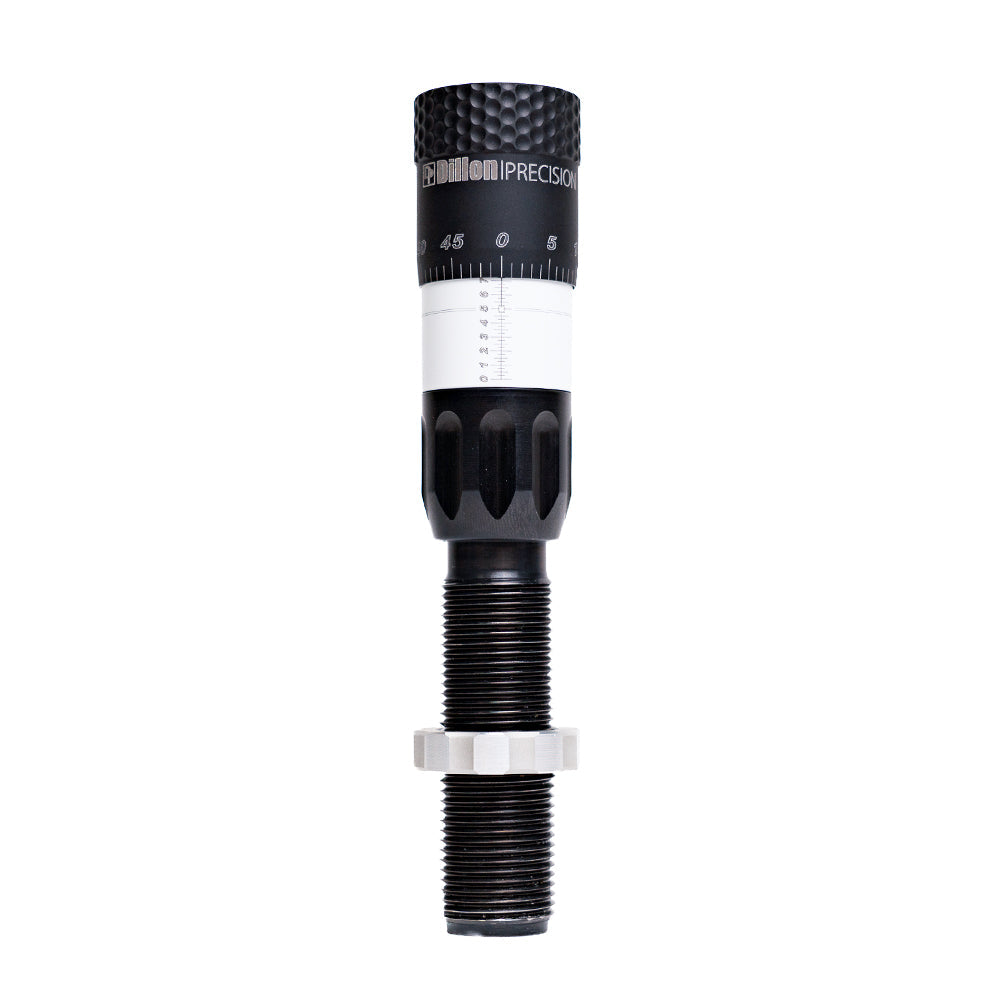
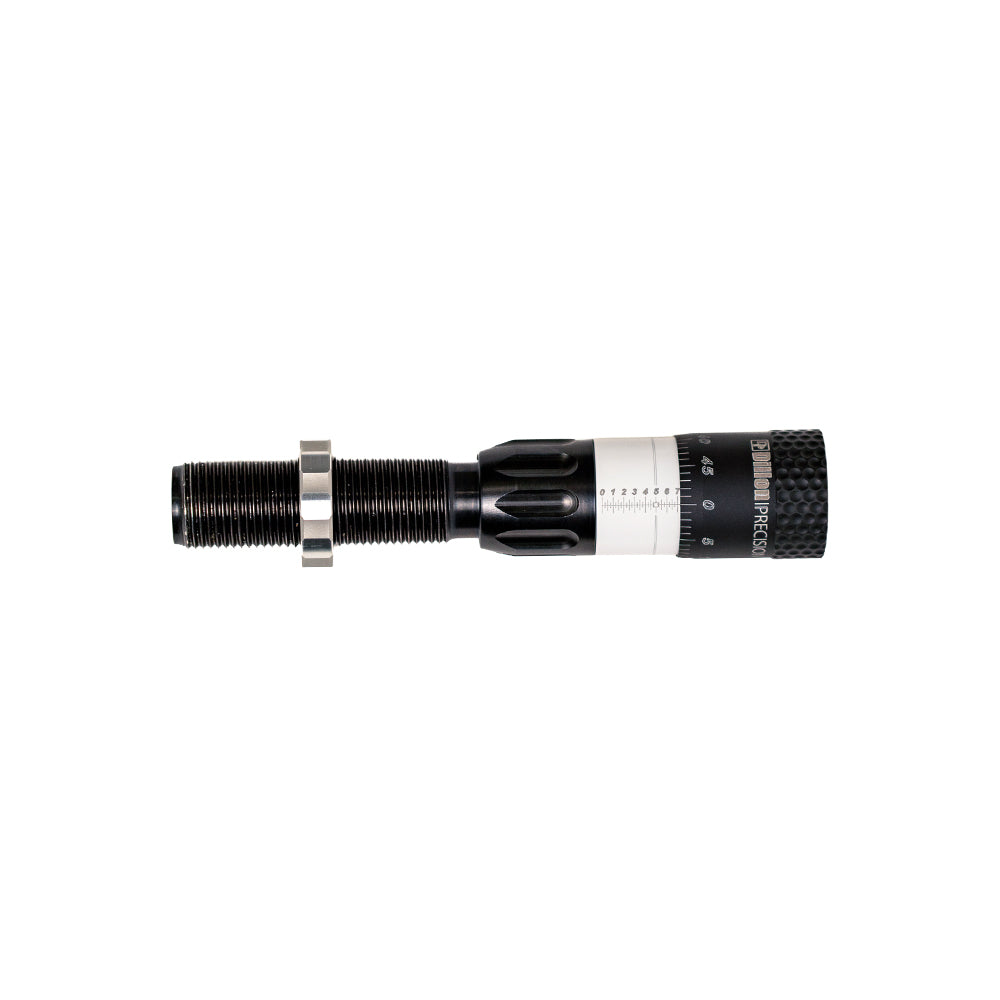
Accurized Micrometer Bullet Seating Die | .338 (8.6mm)

Sale price$325.00

Choose Caliber: .338 (8.6mm)
SKU: 40026

The Accurized Micrometer Bullet Seating Die redefines what precision bullet seating means. With one die body and six available interchangeable bullet diameters, it has the most universal range of any micrometer seating die. Each micrometer click adjusts seating depth by 0.001" across 1" of total micrometer travel. The detent clicks are tactile, inspired by and similar to a rifle scope turret.

A round-nosed micrometer stem drives an independent seating stem, so force reaches the bullet the same way on every stroke. A spring-loaded case centering sleeve captures the case and holds it concentric with the stem before the bullet is pushed, which is the mechanical cause of runout.

Both tangent (13-degree) and secant (10-degree) seating stems ship with every die along with a case centering sleeve cut for .338 (8.6mm). Each contacts the bullet as low on the ogive as possible, near the bearing surface, where the profile is most consistent. This virtually eliminates runout. The jacket is left unmarked, which improves aerodynamic performance.

The graduated cylinder rotates independently of the adjustment stem, so the scale can be rotated to face the front of the press regardless of where the die lands in the toolhead. Standard 7/8"–14 thread fits every Dillon progressive machine and other single-stage presses.

Specifications

  • Single click adjustment: 0.001"
  • Adjustment type: detent click
  • Total micrometer travel: 1"
  • Seating stem profiles: tangent and secant - both included
  • Centering system: spring-loaded sleeve
  • Thread size: 7/8"–14
  • Press compatibility: all standard presses
  • Built in Scottsdale, Arizona
  • Lifetime warranty

In the box

  • Micrometer seating die body
  • Tangent (13-degree) seating stem, .338 (8.6mm)
  • Secant (10-degree) seating stem, .338 (8.6mm)
  • Case centering sleeve, .338 (8.6mm)
  • Storage case

This die ships set up for .338 (8.6mm), part number 40026. Please note: The Die includes one Conversion Kit. Additional Conversion Kits are sold separately. Each conversion kit includes two seating stems. Tangent (13 degree) and Secant (10 degree)


Bullet Diameter Coverage

Diameter Examples of cartridges covered
.224
.223 Rem, 5.56 NATO, .22-250 Rem, .220 Swift, .224 Valkyrie, 22 ARC, 22 Creedmoor, 22 Nosler
.243
.243 Win, 6mm Creedmoor, 6mm ARC, 6mm BR, 6 GT, 6mm Dasher, 6mm PPC, 6mm Rem
.264
6.5 Creedmoor, 6.5 PRC, 6.5 Grendel, .260 Rem, 6.5x55 Swedish, 6.5-284 Norma, 6.5x47 Lapua
.284
7mm-08 Rem, .280 Rem, .284 Win, 7mm Rem Mag, 7 PRC, 28 Nosler, 7x57 Mauser
.308
.308 Win, .30-06 Sprg, .300 Blackout, .300 Win Mag, .300 PRC, .300 WSM, .308 Norma Mag
.338
.338 Win Mag, .338 Lapua Mag, .338 ARC, .338-06, 8.6 Blackout

Know Before You Buy

Accurized Micrometer Bullet Seating Die | .338 (8.6mm)

Questions, Answered.

What's the difference between the tangent and secant seating stems?

Tangent and secant describe two bullet nose profiles. A tangent ogive blends into the bearing surface; a secant meets it at a sharper angle. A stem cut for one rides the other on a point rather than a band, and that point moves from round to round. Both stems ship with the die, tangent at 13° and secant at 10°, cut for your bullet diameter, so you match the stem to the bullet instead of settling for whichever one came in the box.

How do I work out which stem to use?

Color the nose of a bullet with a marker, then seat it lightly against each stem in turn and look at where the ink is rubbed away. Whichever stem marks lower on the ogive, with more surface in contact, is the one for that bullet. It takes a minute and it settles the question for that bullet permanently.

Why does contacting low on the ogive matter?

The ogive is the most dimensionally consistent surface on a bullet. The tip is the least. Contacting low on the ogive, near the bearing surface, means the die indexes off the part that doesn't vary, and it leaves the nose unmarked, which matters on thin-jacketed high-BC bullets. It shows up on your comparator as tighter base-to-ogive spread.

How does the spring-loaded centering sleeve work?

As the case rises, a sprung sleeve captures it and holds it concentric with the seating stem before the bullet is pushed. The bullet enters the neck square rather than slightly cocked, which is the mechanical cause of runout. You get straighter ammunition without adding a concentricity step to your process.

How do I set the seating depth the first time?

Seat a dummy round — no powder, no primer — and measure it base to ogive with a comparator. Every click moves seating depth 0.001", so the difference between what you measured and what you want is a click count rather than a guess. Once the round measures where you want it, re-zero the micrometer at that setting. From then on the number on the scale is that load, and you can move off it and come back to it.

Will it fit my press?

Standard 7/8"–14 thread, so it fits any press with a 7/8"–14 die station — the XL750, RL550, RL1100, Super 1050, CP2000 and BL550, and effectively every other brand. Two presses have a station note: on the XL750 the die will not run in station 4, where it fouls the powder measure. Use station 5, or station 3 if you are crimping. On the RL550 station 3 is the intended location; in station 4 the threads can rub the ejector wire, so it only works there on taller cartridges that don't need the die threaded down to the shellplate. The Square Deal B is the one press it does not fit: it uses Dillon's own SDB dies and loads handgun calibers only.

Do I need a Dillon press to use it?

No. The lock ring is cut to seat correctly on single-stage presses as well as on Dillon progressives, so the same die and the same lock ring move between a 1050 on the bench and a single stage used for load development. It also works on free-float presses such as the Forster Co-Ax and the Short Action Customs Nexus.

Can I use it for pistol cartridges?

No. The die is built for rifle-profile projectiles only, and the seating stems are cut for rifle ogives. It is not intended for handgun bullet profiles.

How do I add another bullet diameter?

Order the conversion kit for that diameter. It carries both stem profiles and the diameter-specific case centering sleeve, and the die body doesn't change. Swap, re-zero, load. Covering all six this way costs a fraction of six dedicated micrometer dies.

Which part number do I need?

Order by bullet diameter rather than by cartridge.

Complete die: .224 40021 · .243 40022 · .264 40023 · .284 40024 · .308 40025 · .338 40026

Conversion kit: .224 40027 · .243 40028 · .264 40029 · .284 40030 · .308 40031 · .338 40032

If you are not sure which diameter your cartridge uses, the coverage table on this page lists the common ones.

Why is it more than other micrometer seating dies?

It covers a bullet diameter rather than one cartridge. Most premium seating dies are cut for a single cartridge, so three cartridges means three dies, three boxes and three setups. This one moves to the next diameter in the family with a conversion kit, and both ogive stems and the spring-loaded centering sleeve are in the box rather than sold as accessories. On a bench that loads more than one cartridge the arithmetic is different from the shelf price.

What does "free-rotating micrometer" mean in practice?

On most dies the scale ends up wherever the threads leave it. Here the graduated cylinder turns independently of the adjustment stem: set your depth, then spin the scale to face the front of the press. You read your own setting without leaning over the toolhead.

Specs

  • Single click adjustment: 0.001"
  • Adjustment type: detent click
  • Total micrometer travel: 1"
  • Micrometer: re-zeroable, with a free-rotating scale
  • Seating stem profiles: tangent 13° and secant 10°, both included
  • Micrometer stem: round-nosed, drives an independent seating stem
  • Centering system: spring-loaded case centering sleeve
  • Thread size: 7/8"–14
  • Press compatibility: any 7/8"–14 die station
  • Projectile type: rifle profiles only
  • Bullet diameters: 6 — .224, .243, .264, .284, .308, .338
  • Die part numbers: 40021–40026
  • Conversion kit part numbers: 40027–40032
  • Built in Scottsdale, Arizona
  • Lifetime warranty

Technical Features

  • 0.001" per click, with a detent click inspired by a rifle scope turret
  • 1" of total micrometer travel, covering the seating range for almost any rifle caliber
  • Includes two seating stems for both tangent and secant profile projectiles
  • Contact low on the ogive, near the bearing surface, where the bullet is dimensionally consistent
  • Spring-loaded case centering sleeve aligns the case to the bullet during the seating operation
  • Round-nosed micrometer stem drives an independent seating stem, so force arrives the same way every stroke
  • Free-rotating scale turns to face you whichever way the die locks down